
Older High Schoolers a Secular Factor in Young Adults Living at Home
Friday, August 12, 2016 by Zelman & Associates
Filed under: Demographics
As of the 2010 Decennial Census, 77.6% of 18-19 year olds lived at home with their parents or grandparents, 240 basis points higher than in 2000, which is at least partly related to a less favorable employment backdrop in 2010 when the national unemployment rate averaged 9.6% versus 4.0% in 2000. From a housing perspective, obviously more young adults living at home means fewer living on their own and demanding incremental shelter.
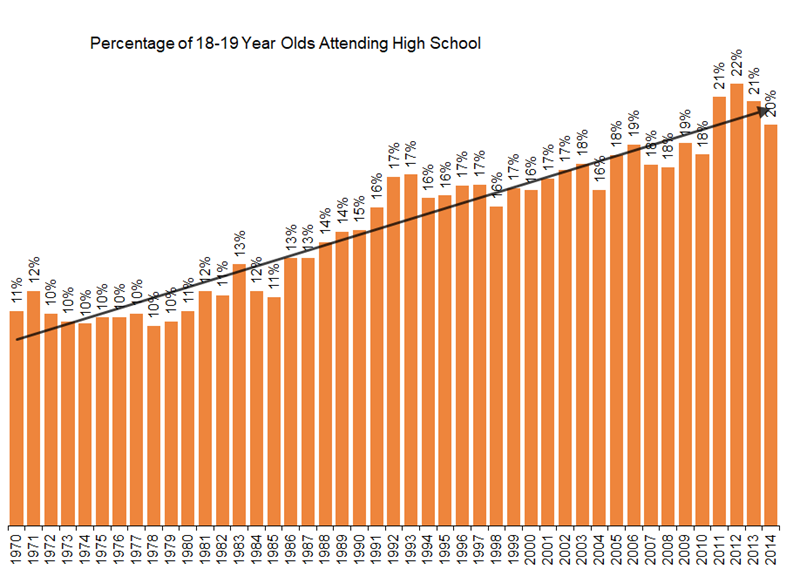
While macro analyses of young adults in recent years have suggested a cultural shift in behavior versus prior generations, it is worth noting that the share of 18-19 year olds attending high school has been on an upward trend for the last several decades as elementary school registration cut-off dates have changed through time, parents opt to hold back their children at an increasing rate and numerous states have passed laws that require students to be held back if they do not pass certain thresholds on standardized tests. As a result, in 2010, 18% of 18-19 year olds were attending high school versus 16% in 2000, 15% in 1990 and 11% in 1980.
Speaking to the impact of varying state laws, the share of 18-19 year olds in high school is well above average in Alaska, Missouri, Mississippi and Virginia, all surpassing 35% while it is only 10% or less in New York, Kansas, South Dakota and Pennsylvania.
With respect to our demographic modeling and outlook for household formation, we assume that the share of young adults living at home will be higher than in the past due to secular trends such as rising average high school ages and increasing college participation rates, but we stop short of believing that the recent increase is structural given the many cyclical effects that have impacted young adults. As such, we continue to anticipate a tailwind to household formation as these recessionary headwinds fade.
Friday, August 12, 2016 by Zelman & Associates
Filed under: Demographics
Looking for More Insightful Content?
Explore our ResearchAffordabilityApartmentsBaby BoomersBuild-For-RentBuilding ProductsConstruction LendingConsumerDemographicsEntry-LevelExisting Home SalesHome ImprovementHome PricingHomebuildingHomeownershipHousehold FormationHousingHousing StartsInstitutional InvestorsInterest RatesM&AMacro HousingManufactured HousingMillennialsMortgageMortgage RatesNew Home SalesReal Estate ServicesRefinanceSG&ASingle-Family RentalSpeakers BureauStocksStudent DebtSupplySurvey