
For Millennials, Willing to Sacrifice Walkability for Affordability
Friday, November 4, 2016 by Zelman & Associates
Filed under: AffordabilityEntry-LevelMillennials
There remain varying opinions as to how young adults will view their housing decisions relative to prior generations, with some arguing for a lower sustainable homeownership rate and a more urban than suburban mix. Our demographic work indicates that young adults are indeed forming families later in life than prior generations, but we believe that they will end up in a similar place as their parents and grandparents with respect to living situations.
One data point to support this view: according to the 2010 Decennial Census, 70% of 35-39 year old households had a child, showing no meaningful difference from 2000 (69%) and 1990 (71%). Young adults might be waiting to have children, but they are still having them and that means that their choice of shelter probably has not changed to the degree assumed by many.
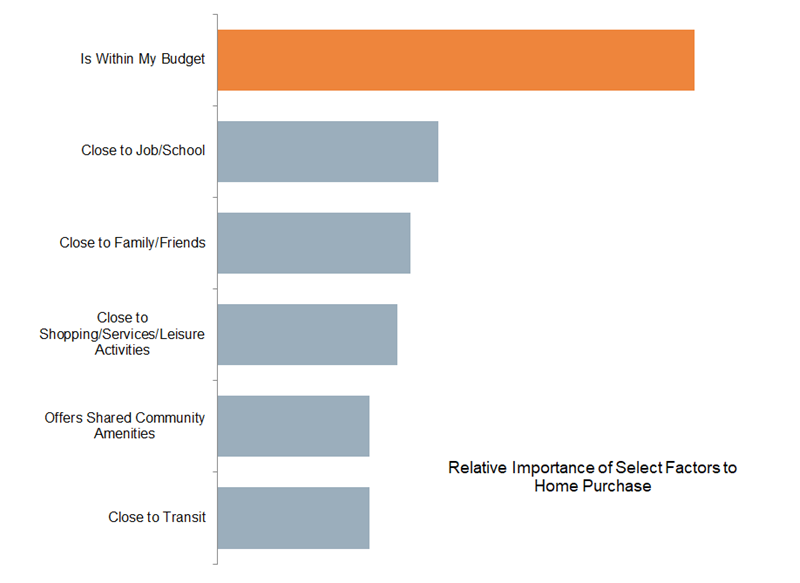
As it relates to the urban-versus-suburban debate, consumer responses to a recently-released national survey conducted blindly on behalf of Zillow Group provide interesting perspective. One question asked recent buyers to rank the importance of various factors in their decision. The most important factor, by a wide margin, was “is within my budget” ranking more than twice as important as “close to job/school” and roughly three times more important than “close to shopping/services/leisure activities”, “close to transit” and “offers shared community amenities”.
So what does this mean? All market participants would surely agree that a home in a great location, near work, friends, family and social activities is most desirable. But that is not the reality of choice for the vast majority of homebuyers, particularly at the entry-level price point. So the question comes down to where the average consumer sacrifices most. This survey suggests that commute times and the walkable amenities that are assumed by others to be so important to young adults are taking a backseat to affordability. And affordability and distance from the employment center are often directly linked. We believe this is why homebuilders are currently having such success with lower priced entry-level product further from the urban core and we continue to believe that the incremental investment in these areas is critical to returning single-family housing starts to historical norms.
Friday, November 4, 2016 by Zelman & Associates
Filed under: AffordabilityEntry-LevelMillennials
Looking for More Insightful Content?
Explore our ResearchAffordabilityApartmentsBaby BoomersBuild-For-RentBuilding ProductsConstruction LendingConsumerDemographicsEntry-LevelExisting Home SalesHome ImprovementHome PricingHomebuildingHomeownershipHousehold FormationHousingHousing StartsInstitutional InvestorsInterest RatesM&AMacro HousingManufactured HousingMillennialsMortgageMortgage RatesNew Home SalesReal Estate ServicesRefinanceSG&ASingle-Family RentalSpeakers BureauStocksStudent DebtSupplySurvey