
Reversing Roles – Multi-Generational Households Where Parents Live With Children
Friday, January 27, 2017 by Zelman & Associates
Filed under: Baby BoomersDemographicsHousehold Formation
Household formation is at the root of incremental housing demand. A thorough forecast of household formation should encompass population growth trends segmented by age cohorts and a detailed understanding of age-specific shifts in how people live. Some of the most obvious factors to consider should be family formation trends, immigration, young adults’ living preferences, the health of older adults and housing affordability.
One area of focus of late has been the emergence of “multi-generational households”, which captures situations where one household covers two or more adult generations, or one that includes grandparents and grandchildren. In fact, according to a Pew Research Center analysis published in August, 19% of the U.S. population fell into this categorization in 2014 versus 12% in 1980. The obvious question is if there are more generations doubling up today versus the past, doesn’t housing suffer? The short answer is yes, but the longer answer is more complicated as there are several moving pieces to consider.
In this article, we specifically explore the piece of the puzzle related to parents living in their adult child’s house. In other words, predominantly elderly individuals where health, finances or some other personal preference has led them to no longer require their own household. To date, these living situations are a small minority for the older population, but it has grown modestly and with the aging of the baby boomers and shifting cultural preferences, it is an important dynamic to monitor, in our opinion.
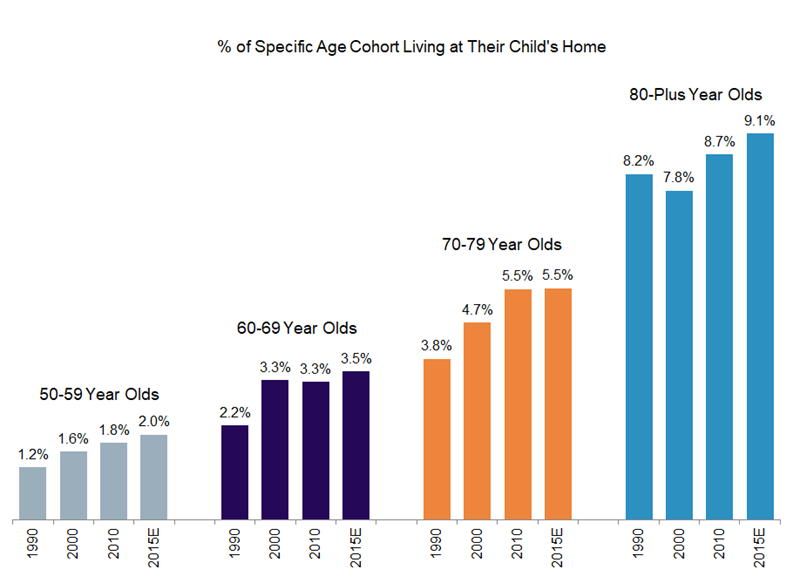
Specifically, in 1990, 2.7% of 50-plus year olds lived in their child’s home, ranging from 1.2% for 50-59 year olds to 8.2% for 80-plus year olds. Fast forwarding to 2010, those figures stood at 3.6%, 1.8% and 8.7%, respectively, and further moderate increases have been evident thus far in the current decade.
To quantify this impact on household formation, from 1990-2000 we estimate that approximately 270,000 fewer households were formed than if the share of 50-plus year olds living with their child held constant. Similarly, from 2000-10, the headwind was an estimated 200,000 households. Likely at least partially due to the recession, the current decade pace would suggest a drag of roughly 290,000.
These figures might seem large but relative to actual household formation of 13.5 million from 1990-2000 and 11.2 million from 2000-10, it represents a headwind of less than 2%. Nevertheless, it’s a necessary component of the equation factored into our bottoms-up demographic analysis and it is gaining mindshare among some production homebuilders such as Lennar via its NextGen floor plan.
Friday, January 27, 2017 by Zelman & Associates
Filed under: Baby BoomersDemographicsHousehold Formation
Looking for More Insightful Content?
Explore our ResearchAffordabilityApartmentsBaby BoomersBuild-For-RentBuilding ProductsConstruction LendingConsumerDemographicsEntry-LevelExisting Home SalesHome ImprovementHome PricingHomebuildingHomeownershipHousehold FormationHousingHousing StartsInstitutional InvestorsInterest RatesM&AMacro HousingManufactured HousingMillennialsMortgageMortgage RatesNew Home SalesReal Estate ServicesRefinanceSG&ASingle-Family RentalSpeakers BureauStocksStudent DebtSupplySurvey