
Are Boomers Really Downsizing to Multi-Family? Not According to the Data
Friday, February 10, 2017 by Zelman & Associates
Filed under: Baby BoomersDemographics
The baby boom generation spans births from 1946-64, making those individuals 52-70 years old today. As has been the case since birth, the significant size of the baby boomers versus the prior generation makes understanding any shift in behavior incredibly relevant for housing.
One theory related to the baby boomers is that their aging is creating a gap in single-family housing demand as they downsize to multi-family living for convenience and maintenance reasons. The byproduct would be more single-family inventory for-sale than younger buyers can absorb.
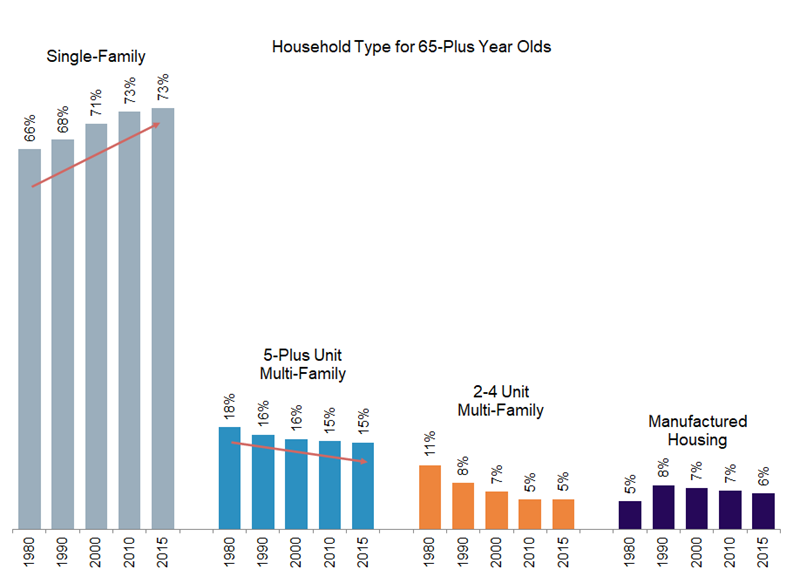
While revitalized urban core areas across the country are certainly making for more attractive options for young and old households alike, on a macro level, our analysis of housing preferences by age indicates that the single-family market is actually gaining share among the 65-plus age cohort.
For instance, in 1980, 66% of 65-plus year old households were of the single-family variety versus 18% for multi-family buildings with at least five units. The remainder was in multi-family buildings with 2-4 units (11%) and manufactured housing (5%). Over each of the next three decades, the share living in single-family homes increased, climbing to 68% in 1990, 71% in 2000 and 73% in 2010. That share held steady at 73% as of 2015.
Conversely, the share in multi-family buildings with five or more units dropped to 16% in 1990 and 2000 and then to 15% in 2010 and 2015. Multi-family buildings with 2-4 units also lost share over the last few decades while manufactured housing got a lift in the 1990s but has since declined.
Aside from personal preference, we attribute the increase over time to expanding life expectancies and improved health allowing older households to maintain a single-family residence longer; later retirement ages; and a consistent trend of young adults getting married and having children at progressively older ages over recent decades, which also means that the children are off the payroll and out of the house later in life.
We have often found in our demographic work that the narrative can be disconnected from the underlying data. In many cases, we believe that is true with respect to the baby boomers, particularly related to the assumption that there is a cliff in housing demand when they pass (we don’t believe there is), that they are creating a headwind for single-family demand (the opposite is true at present) or that they disproportionately live in “McMansions” (they don’t).
Friday, February 10, 2017 by Zelman & Associates
Filed under: Baby BoomersDemographics
Looking for More Insightful Content?
Explore our ResearchAffordabilityApartmentsBaby BoomersBuild-For-RentBuilding ProductsConstruction LendingConsumerDemographicsEntry-LevelExisting Home SalesHome ImprovementHome PricingHomebuildingHomeownershipHousehold FormationHousingHousing StartsInstitutional InvestorsInterest RatesM&AMacro HousingManufactured HousingMillennialsMortgageMortgage RatesNew Home SalesReal Estate ServicesRefinanceSG&ASingle-Family RentalSpeakers BureauStocksStudent DebtSupplySurvey