
Are We in the Midst of a Wedding and Baby Boom and Don’t Realize It?
Friday, April 21, 2017 by Zelman & Associates
Filed under: DemographicsHousehold Formation
Earlier this week, the Census Bureau published a report titled “The Changing Economics and Demographics of Young Adulthood: 1975-2016”, which analyzed changes in how young adults have been educated, started families and lived over the last 40 years. We have previously discussed many of these changing dynamics, including recent delays in marriage and children that we believe reflect both secular and cyclical factors.
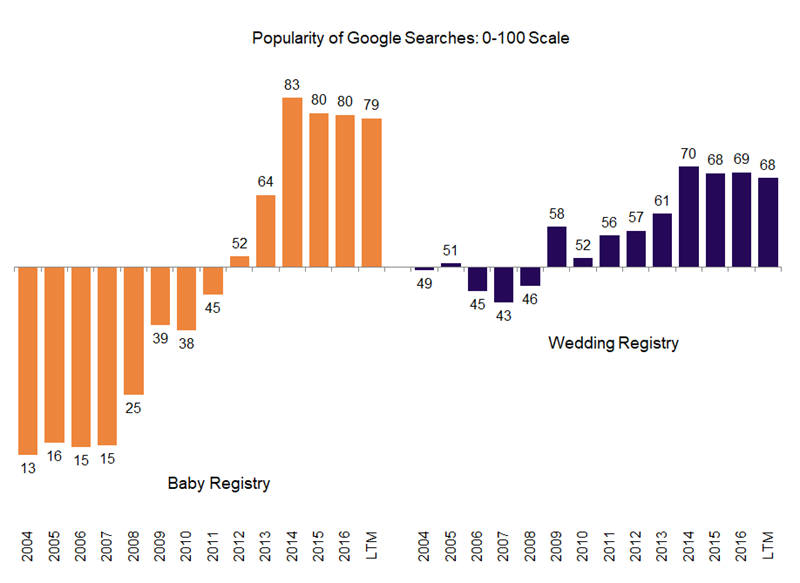
However, our new analysis of Google internet searches indicates that the cyclical factors that negatively affected marriage and birth rates are rapidly fading. If this is a true indication of consumer behavior, it would be an incremental demographic tailwind for single-family living.
More specifically, Google offers the ability to analyze the relative popularity of national search trends as a proportion of total Google searches. The index is calculated on a 0-100 scale, dates back to 2004 and is comparable through time. Thus, a reading of 0 would mean that the particular search term was the lowest level of popularity over the 13-year history and a level of 100 would mean the most popular time over this period.
To gauge pending marriages and births, we compared popularity of searches for wedding and baby registries. Interestingly, the index for both measures has increased substantially over the last three years. For example, in 2016, the index averaged 69 for wedding registries and 80 for baby registries, similar to 2014 and 2015 near the high end of the annual figures. For comparison, these indices averaged 53 and 37, respectively, from 2008-11. This relative improvement is a very important signal from our perspective.
In our opinion, it is not surprising to see some of the recessionary headwinds that impacted young adults’ finances and living situations, and in turn family formation, begin to reverse and normalize. Without question, we believe that the secular trend of young adults getting married and having children at later ages than prior generations is occurring, but this slow-and-steady dynamic has been in place for the last several decades while the Great Recession impacts are more temporary in nature.
To the degree that young adult family formation is set to accelerate, as indicated by the robust Google data, it would be most beneficial to single-family living. As a reminder, if we isolate the 30-39 year-old cohort for arguments sake, the share living in a single-family home rises significantly from those living alone (38%), to living with roommates but no children (51%), married without children (64%) and married with children (80%).
Friday, April 21, 2017 by Zelman & Associates
Filed under: DemographicsHousehold Formation
Looking for More Insightful Content?
Explore our ResearchAffordabilityApartmentsBaby BoomersBuild-For-RentBuilding ProductsConstruction LendingConsumerDemographicsEntry-LevelExisting Home SalesHome ImprovementHome PricingHomebuildingHomeownershipHousehold FormationHousingHousing StartsInstitutional InvestorsInterest RatesM&AMacro HousingManufactured HousingMillennialsMortgageMortgage RatesNew Home SalesReal Estate ServicesRefinanceSG&ASingle-Family RentalSpeakers BureauStocksStudent DebtSupplySurvey