
Share of Children Being Born Out of Wedlock Rising, Even Among Well-Educated
Friday, May 19, 2017 by Zelman & Associates
Filed under: DemographicsMillennials
The Census Bureau recently released data sourced from the Fertility Supplement to the Current Population Survey, which is an analysis conducted every other year about childlessness and children born to women by demographic characteristics such as age and marital status. The release got us thinking about how often children are born out of wedlock today versus prior generations and if there are any implications for housing demand. We utilized the June 2016 data for our analysis.
We know from other demographic macro data that young adults in recent decades have been increasingly delaying marriage and children into later in life. However, interestingly, those two things have not been delayed at the same pace. For example, in 2016, approximately 425,000 children were born to women that were 25-29 years old and were first-time mothers. Only 42% of these women were married at the time of birth with another 33% living with their unwed partner and the remaining 25% being unwed and not living together.
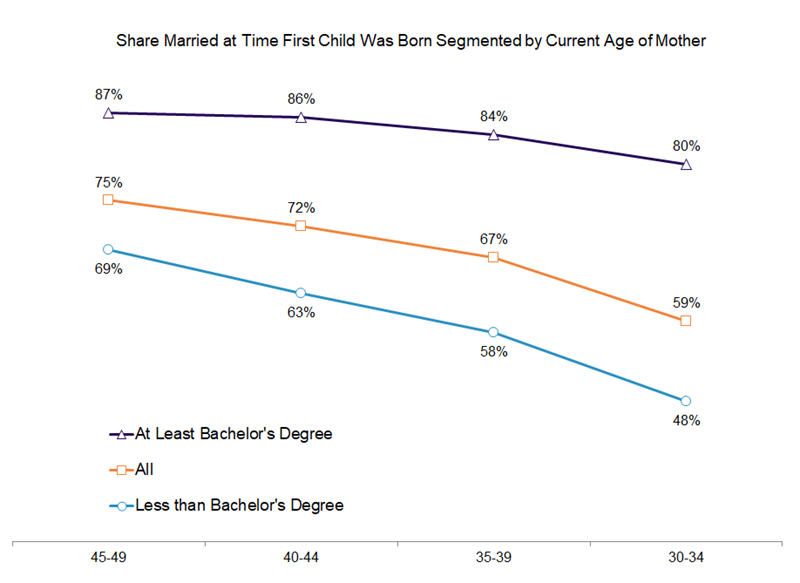
Looking at other age cohorts today and their status at the time of their first child provides perspective on shifting societal views toward marriage and children. For instance, 59% of women that are 30-34 year olds today were married at the time of their first child, which rises further to 67% for 35-39 year olds, 72% for 40-44 year olds and 75% for 45-49 year olds. Very simply, even though the average age of first-time mothers has increased roughly two years over the last two decades, the propensity to be married at the time of birth has declined.
This data can be sliced various ways in an attempt to better understand causation with us picking college attainment as a starting point to determine if well-educated, and indirectly higher income, women were more or less prone to the shift. As it turns out, the trend of having children out of wedlock at an increasing rate is evident in both women with less than a college education and those that are college-educated, although the increase for the less well-educated has been more pronounced.
For instance, looking at 30-34 year olds, 80% of women with a college education were married at the time of childbirth versus 87% for 45-49 year olds. For those without a college education, 48% of first-time mothers were married at time of birth, well below 69% for 45-49 year olds.
The good news as it relates to housing is that the shortfall of marriage is largely being offset by the parents living together outside of marriage, arguably creating a similar living environment without the marital designation. For example, among the well-educated, if living together as a partner was combined with those that were married it would cover 92-93% of first-time mothers that were 30-34, 35-39, 40-44 and 45-49 – indicating little impact on housing needs over time. Nevertheless, with women without a college education increasingly giving birth outside of marriage or living without the father, we believe it’s a trend worth monitoring as it relates to our household formation outlook.
Friday, May 19, 2017 by Zelman & Associates
Filed under: DemographicsMillennials
Looking for More Insightful Content?
Explore our ResearchAffordabilityApartmentsBaby BoomersBuild-For-RentBuilding ProductsConstruction LendingConsumerDemographicsEntry-LevelExisting Home SalesHome ImprovementHome PricingHomebuildingHomeownershipHousehold FormationHousingHousing StartsInstitutional InvestorsInterest RatesM&AMacro HousingManufactured HousingMillennialsMortgageMortgage RatesNew Home SalesReal Estate ServicesRefinanceSG&ASingle-Family RentalSpeakers BureauStocksStudent DebtSupplySurvey