
“Good” Births Up Strongly For Sixth Straight Year as Family Formation Accelerates
Friday, June 2, 2017 by Zelman & Associates
Filed under: Demographics
Final birth statistics for 2016 have yet to be released by the Center for Disease Control and Prevention, but we utilized preliminary data to estimate the results. We recently raised the question of whether “we are in the midst of a wedding and baby boom and don’t realize it.” When the 2016 birth data are released, the answer to the question will appear to be no; however, we believe there is more to the story.
In 2015, national births were down 0.2%, marking the sixth time out of the last eight years that births were down, with 2014 (up 1.4%) and 2012 (flat) the exceptions. Based on our analysis, we estimate that births in 2016 were down an even larger 0.6%, tying 2011 and 2012 as the lowest absolute amount since 1998. While that message does not appear to offer a positive catalyst for family formation and single-family housing demand, there are significant variations among age cohorts.
First, births to teenagers remain in substantial secular decline, which we assume is a net positive for society and a limited drag on housing demand given that we suspect the majority of teenage mothers are in below-average income situations. Specifically, in 2016, we estimate that births to teenagers declined 9.0% year over year, becoming the seventh consecutive annual decline of at least 7.4%. In fact, these births are down a staggering 53% since the near-term peak in 2007.
On the other end of the spectrum, 30 year old women are carrying the baby bearing baton, which we attribute to delayed family formation during the recession and the secular shift of women getting married and starting families later in life. According to our estimates, births to 30 year old women increased 2.6% in 2016, slight acceleration from 2.1% growth in 2015 and leaving the compounded annual growth rate at 2.6% from 2010-16 versus a 0.2% decline from 2003-10. Put another way, approximately 7.8% of 30 year old women gave birth in 2016, up from a recessionary trough of 7.1% in 2010 and 22% higher than the 6.4% share in 2000.
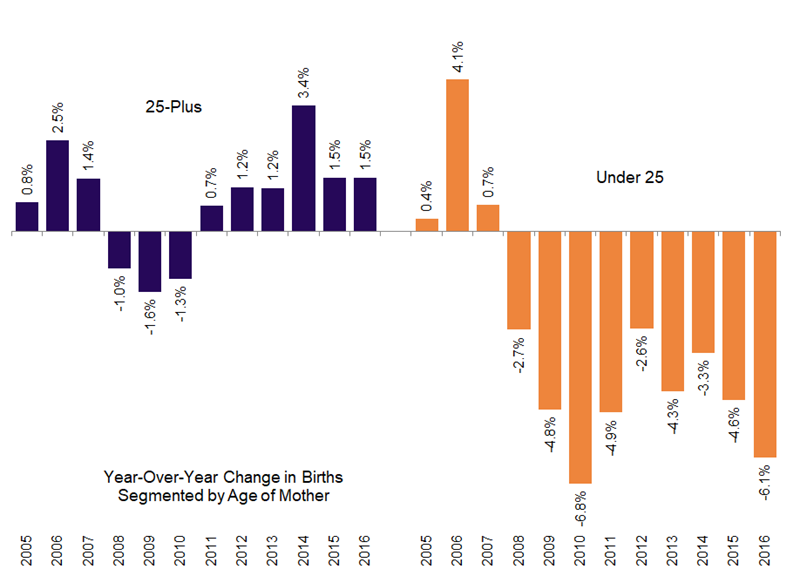
Falling in the middle of the equation, birth trends for women in their 20s are more mixed. In aggregate, births for this cohort are under pressure as the secular pressures on 20-24 year olds more than overwhelm stability in the 25-29 cohort. For instance, we estimate 2016 births were down 5.4% for 20-24 year old mothers and held flat for those 25-29. Combined, there was a 2.3% decline. Looking at the longer-term trend, the annual decline for 20-24 year olds was 2.8% from 2010-16, accelerating from a 1.4% annual drop from 2003-10. On the other hand, these rates were stable for 25-29 year olds at 0.3% and 0.4%, respectively.
For women 25 and older, births increased an estimated 1.5% in 2016, consistent with 2015 as the second strongest rate over the last ten years. Over the last six years, the compounded growth rate of 1.6% was not only materially improved from 0.1% from 2004-10, but also stood at the best such measure since 1992. As we tie the various messages together, we are encouraged by “good” births with respect to housing demand, particularly for single-family homes.
Friday, June 2, 2017 by Zelman & Associates
Filed under: Demographics
Looking for More Insightful Content?
Explore our ResearchAffordabilityApartmentsBaby BoomersBuild-For-RentBuilding ProductsConstruction LendingConsumerDemographicsEntry-LevelExisting Home SalesHome ImprovementHome PricingHomebuildingHomeownershipHousehold FormationHousingHousing StartsInstitutional InvestorsInterest RatesM&AMacro HousingManufactured HousingMillennialsMortgageMortgage RatesNew Home SalesReal Estate ServicesRefinanceSG&ASingle-Family RentalSpeakers BureauStocksStudent DebtSupplySurvey