
Second Kid Typically the Final Straw Before Heading to Suburbs
Friday, August 25, 2017 by Zelman & Associates
Filed under: DemographicsMillennials
We recently detailed that “good” births, or births to women at least 25 years of age, were up 1.5% in 2016 based on preliminary estimates from the Center for Disease Control. While those estimates have been revised lower to reflect 1.1% growth, this still marked the sixth consecutive annual increase (2011-16) after dropping for three straight years overlapping the economic recession (2008-10). For perspective, the 1.5% annual growth over the last six years ranks strongest since 1992.
In addition to strong overall household formation, we pay particularly close attention to family formation and births given that it is the most significant catalyst for households to shift from multi-family to single-family living.
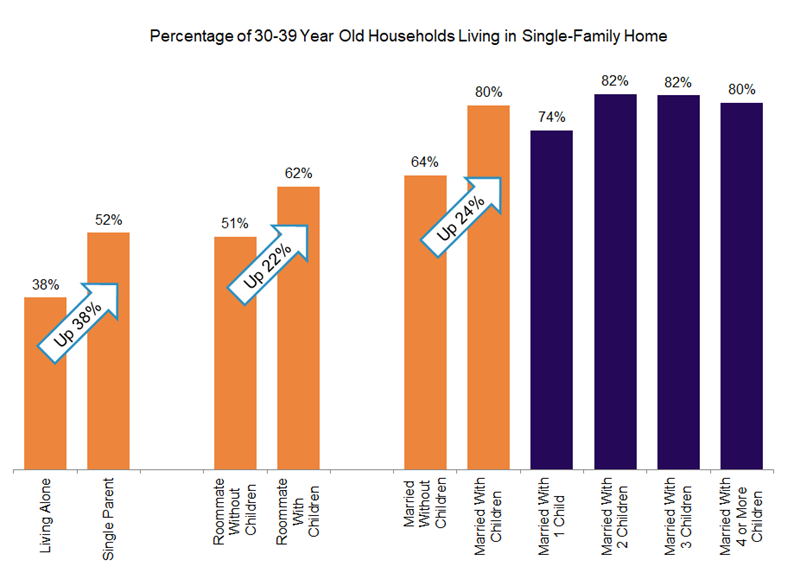
To help illustrate this point, we isolate various demographic situations for the 30-39 year old age cohort and overlay that with the share living in a single-family home, regardless of whether that home is owned or rented. For instance, 38% of 30-39 year olds living alone reside in a single-family home – a surprising stat to many people in isolation – while that ratio jumps to 52% for a single parent.
Similarly, for 30-39 year olds cohabitating without a child in the household, 51% live in a single-family home. Bringing a child into the equation, there is a 22% increase in the propensity to choose single-family living, leaving the share at 62%.
Among married couples, 20% of 30-39 year old households do not presently have children and 64% of these households still choose to reside in a single-family home, even higher than cohabitating situations where a child is present. Once the first child arrives, the single-family share jumps noticeably to 74% as space requirements and different lifestyle priorities dictate the shift. Unsurprisingly, the share climbs even further to 82% when a second child is born and the suburbs become more of a necessity than a preference.
According to our data, the second child is ultimately the deciding point between the suburbs or not as 30-39 year old households with three children are no more likely to be living in a single-family home as those with two children. We believe this is a point worth stressing given rhetoric about the current generation of young adults potentially having fewer children than prior generations. If true, with respect to single-family demand it would seemingly only be relevant if the average shifted below two.
Friday, August 25, 2017 by Zelman & Associates
Filed under: DemographicsMillennials
Looking for More Insightful Content?
Explore our ResearchAffordabilityApartmentsBaby BoomersBuild-For-RentBuilding ProductsConstruction LendingConsumerDemographicsEntry-LevelExisting Home SalesHome ImprovementHome PricingHomebuildingHomeownershipHousehold FormationHousingHousing StartsInstitutional InvestorsInterest RatesM&AMacro HousingManufactured HousingMillennialsMortgageMortgage RatesNew Home SalesReal Estate ServicesRefinanceSG&ASingle-Family RentalSpeakers BureauStocksStudent DebtSupplySurvey