
Keep it Simple: A State-Level Look at Population Growth and Housing Demand
Friday, December 29, 2017 by Zelman & Associates
Filed under: DemographicsHousing StartsMacro Housing
Once a year, the Census Bureau releases population estimates for the country, states and local areas, which help to gauge trends between the more expansive decennial censuses. Last week, the national and state estimates as of July 2017 were released. At 2.2%, Idaho claimed the top spot for fastest growing state, following Utah in 2016 and North Dakota the prior three years. Indicative of the quick shift in employment demand following the decline in the energy markets, North Dakota dropped to the eighth slowest state in just two years’ time.
Additionally, speaking to consistent strength, the District of Columbia, Texas, Utah, Florida and Colorado ranked in the top ten each of the last seven years. On the other side, four states ranked consistently in the bottom ten in each of these years, including West Virginia, Vermont, Illinois and Mississippi. Beyond the obvious, these metrics are important because it is population growth that drives housing demand, not the size of the population.
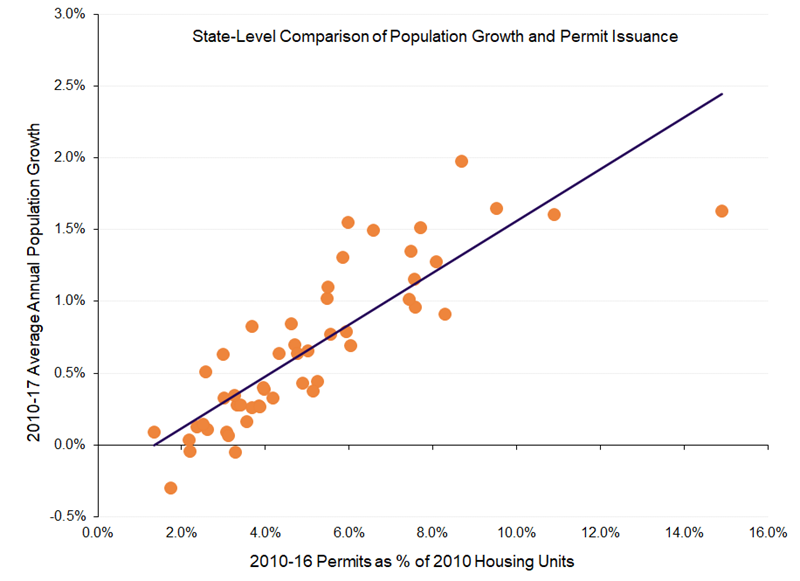
While this might appear intuitive, we frequently come across some form of the argument that housing starts (or permits) should be higher today than in the past because the population is larger. That is a very misleading conclusion. Rather, new construction is an incremental measure of housing supply and should be compared to the incremental measure of housing demand, which can be generalized as population growth in the absence of reliable household formation statistics at the state level.
For example, from 2010-16 there were approximately 6.5 million single-family and multi-family permits issued for new construction, equaling 4.8% of the housing stock as of the April 2010 Decennial Census. The five strongest areas on this measure were North Dakota (14.9%), Utah (10.9%), Texas (9.5%), the District of Columbia (8.7%) and South Dakota (8.3%). Not surprisingly, while South Dakota ranked 16th in population growth over this time frame, the other four new construction winners were also the four strongest areas for population growth.
The correlation between population growth and permits issued as a percentage of housing stock is a strong 85%. Interestingly, looking forward, we believe that several states could experience new construction housing demand beyond what demographics alone would dictate as the rate of new supply has trailed the change in population over time while recent trends remain strong. These include Massachusetts, California, Florida, Montana and Arizona.
Friday, December 29, 2017 by Zelman & Associates
Filed under: DemographicsHousing StartsMacro Housing
Looking for More Insightful Content?
Explore our ResearchAffordabilityApartmentsBaby BoomersBuild-For-RentBuilding ProductsConstruction LendingConsumerDemographicsEntry-LevelExisting Home SalesHome ImprovementHome PricingHomebuildingHomeownershipHousehold FormationHousingHousing StartsInstitutional InvestorsInterest RatesM&AMacro HousingManufactured HousingMillennialsMortgageMortgage RatesNew Home SalesReal Estate ServicesRefinanceSG&ASingle-Family RentalSpeakers BureauStocksStudent DebtSupplySurvey