
Is Trump to Blame for Lack of Baby Bump?
Friday, June 1, 2018 by Zelman & Associates
Filed under: Demographics
From 2007-16, national births declined 9% in total and 1.0% per year, a drag that has been unmatched over the last four decades, which can be attributed to slower adult population growth, shifting age cohorts, secular changes in young adult habits and lingering effects from the Great Recession.
However, a year ago, we highlighted that the message was actually quite positive for "good births", which we termed those to mothers at least 25 years old. For this cohort, births increased 1.2% in 2016 and increased 1.5% over the trailing six years, a high watermark since 1992.
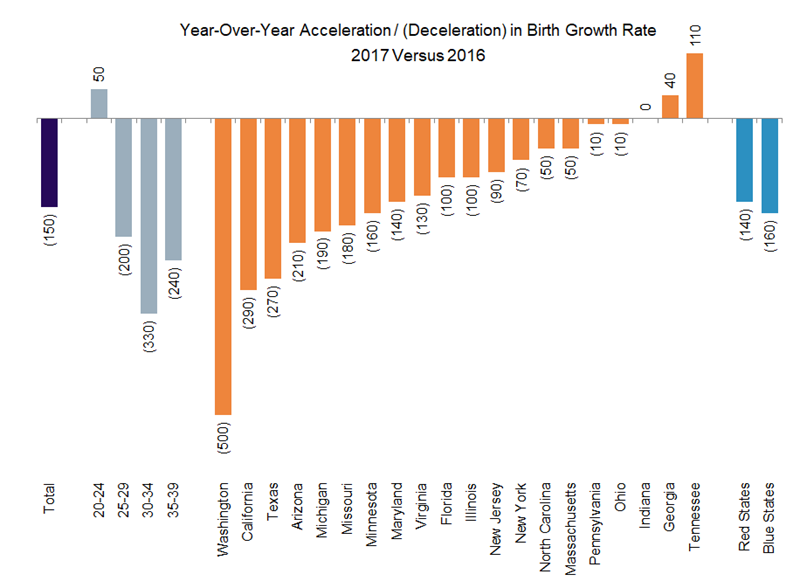
Unfortunately, preliminary 2017 data released by the Center for Disease Control and Prevention (CDC) revealed a stark reversal. Births in 2017 were down a surprising 2.3% year over year, decelerating 150 basis points from the 2016 change. A decline in isolation is not surprising given the expected drag from young cohorts, but a decrease this large was shocking. The drop rivals the Great Recession overhang in 2009 (down 2.8%) and 2010 (down 3.2%).
On the positive side, births by teenagers declined 7.5%, remarkably dropping by at least 5.8% for nine consecutive years. The last time teenage births increased was in 2007. Since then, there has been a staggering 57% decrease. However, births for mothers at least 25 years old declined 1.3% year over year, nearly matching the worst result (down 1.6%) over the last four decades. The deceleration was also evident across all races, aside from Black, and 39 states and the District of Columbia.
Recognizing the gestation period of nine months, this suggests a material shift in behavior from March 2016 through March 2017 versus the prior-year period. The only logical overarching catalysts could have been the election and its polarizing candidates, but even that is hard to pinpoint. Splitting states into their Republican and Democratic voting skew for the presidential election reveals similar rates of deceleration from 2016 at 140 basis points and 160 basis points, respectively.
Generally, births tend to contract around recessionary episodes and accelerate during economic recoveries, but it is not without annual volatility within the cycle as we have found virtually no correlation in growth of “good” births and the national unemployment rate. For example, growth in births for this age cohort ranged from 0.6-2.7% during 2002-06, and from 0.1-2.9% during 1996-2000. Thus, volatility is not new, but we certainly would not have bet on 2017 shifting to a sizeable decline given the strength in entry-level housing. We are optimistic that the 2017 decline will prove to be one of these aberrations versus a structural shift and are at least encouraged by improving trends through the year, with 4Q17 flat year over year for 25 and older women versus down 2.0% in 1Q17.
Friday, June 1, 2018 by Zelman & Associates
Filed under: Demographics
Looking for More Insightful Content?
Explore our ResearchAffordabilityApartmentsBaby BoomersBuild-For-RentBuilding ProductsConstruction LendingConsumerDemographicsEntry-LevelExisting Home SalesHome ImprovementHome PricingHomebuildingHomeownershipHousehold FormationHousingHousing StartsInstitutional InvestorsInterest RatesM&AMacro HousingManufactured HousingMillennialsMortgageMortgage RatesNew Home SalesReal Estate ServicesRefinanceSG&ASingle-Family RentalSpeakers BureauStocksStudent DebtSupplySurvey