
Don’t Let Fiction Override Facts When it Comes to Millennials, Births and Housing
Friday, July 13, 2018 by Zelman & Associates
Filed under: DemographicsMacro HousingMillennials
In late May, the Center for Disease Control and Prevention (CDC) released preliminary 2017 birth data. The totals were surprisingly weak after six years of strength among key age cohorts. Naturally, the weakness spurred numerous negative reports from the media, with many speculating about the cause and inferring that dramatic socioeconomic shifts are underway.
Last week, The New York Times revealed the results of a separate survey it conducted of 20-45 year olds about their future birth decisions. While the survey itself appears technically sound, we believe the negative tone of the article missed the bigger picture. Instead, as we often find, the facts lead us to the complete opposite end of the debate.
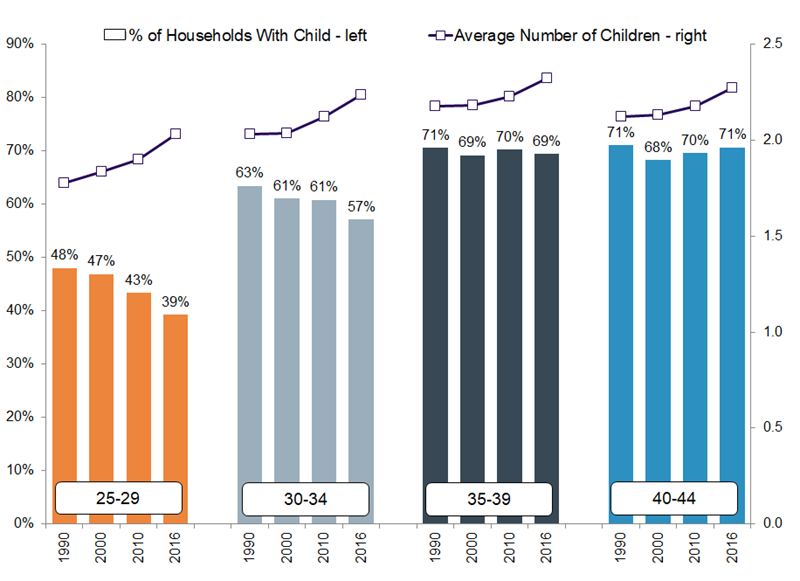
Let’s first start with the following: of those surveyed, “About half were already parents. Of those who weren’t, 42 percent said they wanted children.” In other words, approximately 71% of those surveyed were either already a parent or expected to be. How does that compare to the recent past? It is almost identical to the last four decades! When looking at households headed by 35-39 year olds and 40-44 year olds, roughly 70% had a child present over this period.
So perhaps young adults are having fewer children than in the past? This is implied by the article, stating that “The total fertility rate — which estimates how many children women will have based on current patterns — is down to 1.8, below the replacement level in developed countries of 2.1.” But this figure does not account for shifting age cohorts, such as the increasing share of older households, or the recent plunging rate of teenage births, which is a positive socioeconomic dynamic.
To better answer the question, we analyzed each young adult age cohort to determine how many children were in each house that had at least one child present. Surprisingly, these numbers have been rising, not falling. For example, in 1990, for 35-39 year old households that had a child, the average number equaled 2.18 per household. In 2016, this was higher at 2.32.
It is very difficult to argue that today’s young adults are ending up in any different family position than their parents. They are certainly starting the journey toward children later in life, but the data loudly concludes that it is the trajectory that is different, not the end point.
Friday, July 13, 2018 by Zelman & Associates
Filed under: DemographicsMacro HousingMillennials
Looking for More Insightful Content?
Explore our ResearchAffordabilityApartmentsBaby BoomersBuild-For-RentBuilding ProductsConstruction LendingConsumerDemographicsEntry-LevelExisting Home SalesHome ImprovementHome PricingHomebuildingHomeownershipHousehold FormationHousingHousing StartsInstitutional InvestorsInterest RatesM&AMacro HousingManufactured HousingMillennialsMortgageMortgage RatesNew Home SalesReal Estate ServicesRefinanceSG&ASingle-Family RentalSpeakers BureauStocksStudent DebtSupplySurvey