
Worried About Boomers Selling? – Busting the “McMansion” Myth
Friday, August 10, 2018 by Zelman & Associates
Filed under: Baby BoomersDemographicsMacro HousingMillennials
As of 2017, we estimate that there were approximately 78 million single-family detached homes in the country, of which 65 million were owner-occupied. We further estimate that Baby Boomers – defined as people born from 1946-64 – owned almost 28 million of them. We are often asked, what happens to supply when the Baby Boomers begin selling these homes? Beyond concern about the amount of supply, the question usually carries a negative undertone as there exists a common perception that this generation has accumulated “McMansions” that are oversized for eventual buyers.
As it pertains to timing of Baby Boomers selling, we note that the age range currently spans 54-72 year olds, with the weighted-average sitting at 62 years old. According to our research, the probability of single-family living rises consistently with age before stabilizing when homeowners reach 60-69 years old. Downsizing historically has not begun until one’s early-to-mid 70s, and that is slowly being extended by longer life expectancies. In other words, it will be almost a decade before the heart of the Baby Boomer generation begins gradually selling. We believe the effect is one that will play out over a very long time.
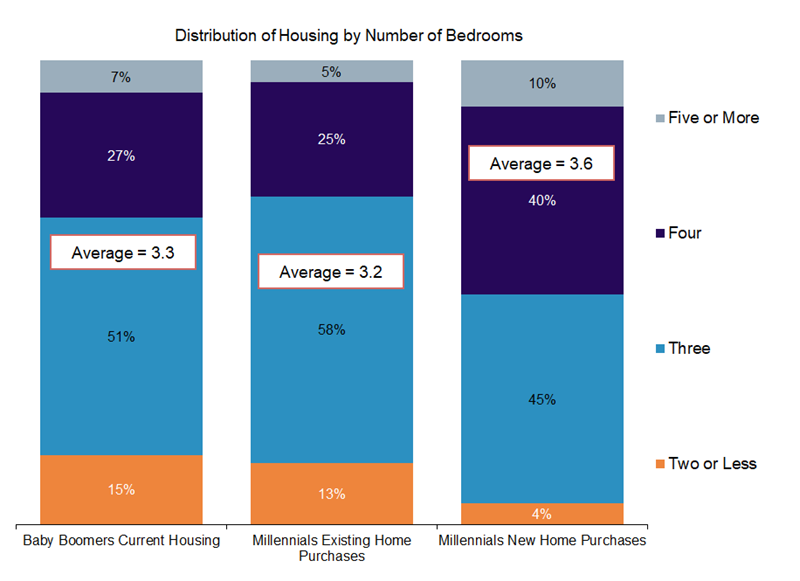
With respect to what they are selling, we believe that the McMansion myth is far beyond reality. Consider that 69% of Baby Boomers reside in homes built before 1990 when new construction homes were routinely less than 1,800 square feet in size. Furthermore, 66% of Baby Boomer homes have three (51%) or two or fewer (15%) bedrooms. Only 27% have four bedrooms and the remaining 7% have five or more bedrooms. In our view, these stats do not align with excessive square footage.
In fact, when looking at what Millennials – defined as those born from 1984-2002 – are buying, it closely matches exactly with what Boomers are selling, and a compelling argument could be made that larger homes would be welcomed. For existing homes, 82% of Millennial purchases had three or four bedrooms versus 78% for Boomers’ assets. Meanwhile, 50% of new construction purchases by Millennials had at least four bedrooms, well in excess of the 34% for Boomers’ stock.
To be clear, when Millennials start from scratch and choose new construction, they are opting for more bedrooms than can be found in the resale market, which is dominated by older, smaller homes. We think many housing market observers have come to the wrong conclusion. The question is not whether Baby Boomers’ homes are too large, but rather, are they too small? Furthermore, are they too dated with closed floorplans and designs that are unappealing to younger buyers? Time will obviously tell, but in our view, homebuilders and companies capable of redeveloping older single-family homes will be the biggest winners as the Baby Boomers age out of their current houses.
Friday, August 10, 2018 by Zelman & Associates
Filed under: Baby BoomersDemographicsMacro HousingMillennials
Looking for More Insightful Content?
Explore our ResearchAffordabilityApartmentsBaby BoomersBuild-For-RentBuilding ProductsConstruction LendingConsumerDemographicsEntry-LevelExisting Home SalesHome ImprovementHome PricingHomebuildingHomeownershipHousehold FormationHousingHousing StartsInstitutional InvestorsInterest RatesM&AMacro HousingManufactured HousingMillennialsMortgageMortgage RatesNew Home SalesReal Estate ServicesRefinanceSG&ASingle-Family RentalSpeakers BureauStocksStudent DebtSupplySurvey