
Want Your Adult Child to Move Out? Find Them Love
Friday, November 2, 2018 by Zelman & Associates
Filed under: DemographicsMillennials
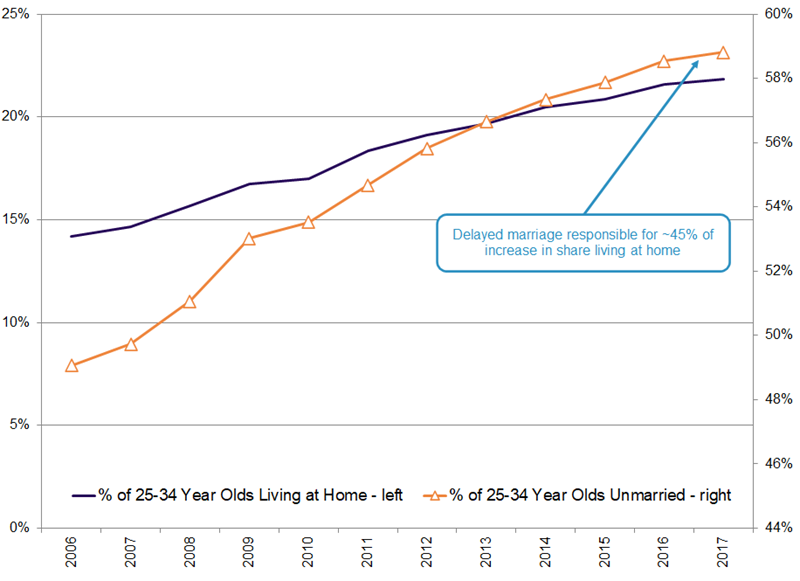
According to the American Community Survey (ACS) conducted by the Census Bureau, 14.2% of 25-34 year olds lived with their parents or grandparents in 2006. That ratio has increased every year since. The most significant annual increases were in 2008, 2009 and 2011 when the Great Recession was a significant overhang on young adults’ job prospects and earnings power. However, even with young unemployment hitting the fourth lowest level over the last three decades, the share of 25-34 year olds living at home hit a new high.
Numerous theories have surfaced for the persistent increase, but most are based on anecdotes and perception rather than hard evidence. With the 2017 detailed ACS data just released, we analyzed numerous factors that one might perceive to be relevant to the conversation. Our analysis focuses entirely on 25-34 year olds.
To start, we note that 25-34 year olds enrolled in college are roughly 25-30% more likely to be living at home than those not attending school. While there was a spike in college attendance during the Great Recession given a poor job market, the share attending school in 2017 was almost identical to 2016 at roughly 12%, so this mix issue is not material.
Excluding 25-34 year olds in school, the other factors we analyzed included race, marital status, employment status, income, college attainment and geography. The overall increase in young adults living at home could be influenced in two ways: (1) a cohort that has a high propensity of living at home being a larger percentage of the population today than in the past; or (2) one or more factors deteriorating over time, forcing a shift in living habits.
Among all these factors and mix issues, marital status stands out in an extreme way. In 2017, only 41% of 25-34 year olds were married, significantly lower than 51% in 2006, dropping each year in between. Not surprisingly, a married person is far less likely to be living with their parents than otherwise. In 2017, only 4% of married people lived at home, similar to 3% in 2016.
Consider that if the mix of married and unmarried 25-34 year olds was constant between 2006 and 2017 the percentage of young adults living at home would be approximately 330 basis points lower. Said differently, approximately 45% of the increase in the share of young adults at home can be pinned on the delay of marriage. No other factor that we analyzed came close to being this important to the conclusion.
We believe that the remaining 55% of the increase can be attributed to a multitude of factors, with none materially more important than another, including shifting social norms, the rising cost of college and higher student debt, different mix of racial cohorts and the hangover of Great Recession effects.
On that last point, we find it interesting that the percentage of 30-34 year olds at home rose by 65% from 2006-17, outpacing the increase for 25-29 year olds (48%) and 20-24 year olds (18%). These 30-34 year old individuals would have been 22-26 when unemployment rates were extremely elevated in 2009-11 and they would have been early in their careers. We believe it is entirely plausible that the slow start to their employment and savings has had a lingering impact on living habits. If so, the less significant increase in younger cohorts should provide optimism for the future.
Friday, November 2, 2018 by Zelman & Associates
Filed under: DemographicsMillennials
Looking for More Insightful Content?
Explore our ResearchAffordabilityApartmentsBaby BoomersBuild-For-RentBuilding ProductsConstruction LendingConsumerDemographicsEntry-LevelExisting Home SalesHome ImprovementHome PricingHomebuildingHomeownershipHousehold FormationHousingHousing StartsInstitutional InvestorsInterest RatesM&AMacro HousingManufactured HousingMillennialsMortgageMortgage RatesNew Home SalesReal Estate ServicesRefinanceSG&ASingle-Family RentalSpeakers BureauStocksStudent DebtSupplySurvey