
What Exactly are Young Adults Living at Home Up To?
Friday, April 5, 2019 by Zelman & Associates
Filed under: DemographicsMillennials
Approximately 34% of young adults are living in their parents’ home, more than at any point over the last 50-plus years, which has remarkable consequences for housing demand. While this fact is well understood and has spawned many questions and insinuations about young adults’ work ethic, we believe important details lay below the surface that are not well analyzed.
As a reminder, the unemployment rate of 18-34 year olds exceeded 10.0% each year from 2009-13. To put this into perspective, those five years compare to just four years of double-digit unemployment over the prior four decades. There should be no mystery about why the share of young adults living at home spiked. Instead, we believe time is better spent understanding the current circumstances of young adults at home and whether hope exists for the generation to move toward normalized household formation.
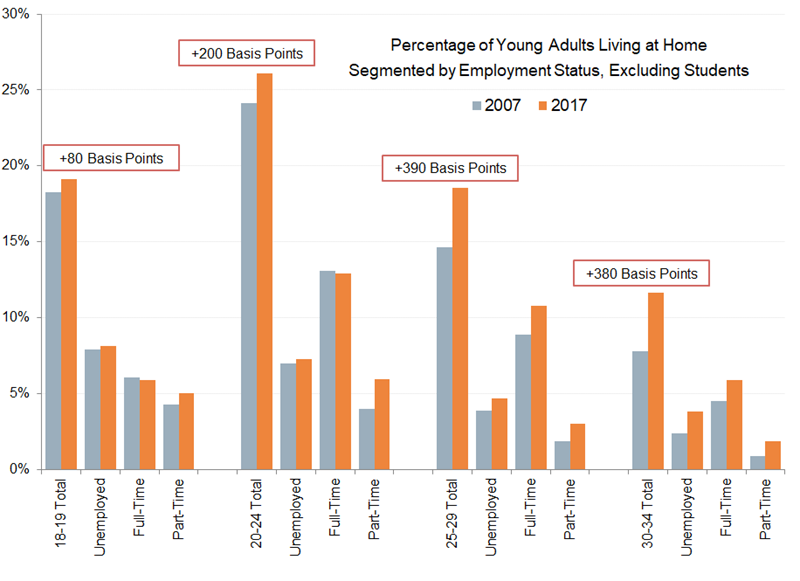
For our analysis, we segment 18-34 year olds into four groups (18-19, 20-24, 25-29 and 30-34) and further detail whether these individuals are in school (high school or college), working (part-time or full-time) or unemployed. We then assess the trends in these metrics over the last ten years.
To start, 18-19 year olds are actually less likely to be living at home today (78%) than ten years ago. The 110 basis point reduction over this period is largely explained by a 190 basis point decline in the share attending school, partially offset by an 80 basis point increase in those that were working part-time. In essence, 18-19 year olds have largely bucked the overall trend of a rising share living at home, but it has come at the expense of education, which might not be the best long-term outcome. Excluding students, 19.1% of 18-19 year olds lived at home, up 80 basis points from 2007.
For 20-24 year olds, the current share at home (49%) is 360 basis points higher than in 2007, driven largely by an increase in the percentage employed part-time (190 basis points) and the share attending school (160 basis points). The share that was unemployed was only 30 basis points higher, offsetting an equal decline in the share employed full-time.
For 25-29 year olds and 30-34 year olds, the circumstances are similar. The share living at home is up most significantly over the last decade, 420 and 410 basis points, respectively, and it has little to do with school attendance, which was up just 30 basis points in both cases.
More importantly, these young adults are much more likely to be working full-time and still living at home, with that share rising by 190 basis points for 25-29 year olds and 140 basis points for 30-34 year olds. They also carry a higher share of unemployed than ten years ago, up 80 and 150 basis points, respectively. In short, these cohorts are most responsible for the atypically high share of 18-34 year olds living at home. Not coincidentally, they are also the age cohorts that were emerging from high school and college when the Great Recession was at its worst, impairing their initial earnings potential.
As we look forward, we assume that cyclical effects from the Great Recession will forever overhang 25-34 year olds relative to generations that did not have to endure such difficult economic times early in their careers. On the other hand, we are encouraged by trends for 18-24 year olds, which suggest that secular fears of an increasing share of young adults willingly living at home are likely overblown.
Friday, April 5, 2019 by Zelman & Associates
Filed under: DemographicsMillennials
Looking for More Insightful Content?
Explore our ResearchAffordabilityApartmentsBaby BoomersBuild-For-RentBuilding ProductsConstruction LendingConsumerDemographicsEntry-LevelExisting Home SalesHome ImprovementHome PricingHomebuildingHomeownershipHousehold FormationHousingHousing StartsInstitutional InvestorsInterest RatesM&AMacro HousingManufactured HousingMillennialsMortgageMortgage RatesNew Home SalesReal Estate ServicesRefinanceSG&ASingle-Family RentalSpeakers BureauStocksStudent DebtSupplySurvey