
As Young Adult Population Growth Slows, Which States are Relative Winners?
Friday, June 28, 2019 by Zelman & Associates
Filed under: DemographicsMillennials
As detailed last December, national population growth for the year ended July 2018 was just 0.62%, modestly softer than 0.64% in the previous year and the weakest annual expansion since 1945. Contrary to popular belief, population growth for 20-34 year olds was below average, at only 0.34%, with the shortfall to total adult population growth the widest since 2006. Given the importance of young adults to household formation, particularly in the multi-family sector, we believe that these data points are underappreciated.
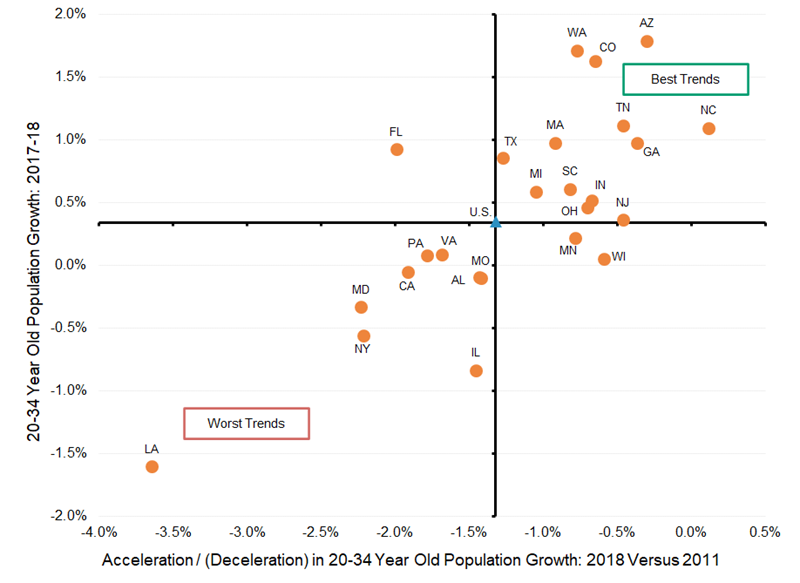
Utilizing recently published state-level population data by age from the Census Bureau, we can explore this dynamic more granularly. In 2018, 20-34 year old population growth was strongest in Nevada (1.9%), Idaho (1.8%), Arizona (1.8%), Utah (1.7%) and Washington (1.7%). The greatest contraction was in Hawaii (1.8%), Wyoming (1.8%), Alaska (1.7%), Louisiana (1.6%) and West Virginia (1.0%).
Nationally, population growth for 20-34 year olds recently peaked at 1.7% in 2011. Despite relative winners and losers by state, the deceleration in growth since then has been a constant theme across the vast majority of the country. Only Nevada, Utah, Idaho and North Carolina posted stronger growth among this age cohort in 2018 than in 2011.
As we have addressed in the past, population and household growth dictate incremental housing demand, not the absolute size of either. Thus, if young adult population growth is slowing and set to turn negative, housing executives should be paying attention. Of course, while we find this to be a discussion with broad-based implications, the relative slowing will vary by geography.
Although some state-by-state winners and losers are as one would expect, our analysis reveals others that are not. To simplify our analysis, we focus on the 25 largest states for young adult population, which accounted for 84% of the total. Among these 25 states, 13 posted above-average 2018 population growth and a relative trend since 2011 that was better than the United States as a whole. Obvious beneficiaries were Arizona, Colorado, Georgia, North Carolina and Washington. But Indiana, Massachusetts, Michigan, New Jersey and Ohio also fall in this camp. Unsurprisingly, California, Illinois, New York, Pennsylvania and Virginia were below average on both metrics.
Friday, June 28, 2019 by Zelman & Associates
Filed under: DemographicsMillennials
Looking for More Insightful Content?
Explore our ResearchAffordabilityApartmentsBaby BoomersBuild-For-RentBuilding ProductsConstruction LendingConsumerDemographicsEntry-LevelExisting Home SalesHome ImprovementHome PricingHomebuildingHomeownershipHousehold FormationHousingHousing StartsInstitutional InvestorsInterest RatesM&AMacro HousingManufactured HousingMillennialsMortgageMortgage RatesNew Home SalesReal Estate ServicesRefinanceSG&ASingle-Family RentalSpeakers BureauStocksStudent DebtSupplySurvey