
Will Declining Marriage Rates Pressure Single-Family Housing Demand?
Monday, May 18, 2020 by Zelman & Associates
Filed under: Demographics
To best answer this question, we dug beyond the headlines and focused more intently on behavior by age cohort, because the aging of the population clearly has an impact on the national calculation and yet this important point is seemingly missing from the dialogue. For instance, over the last decade, 90% of marriages have been to individuals aged 20-55. Shouldn’t we only care about trends within these ages, versus across all ages?
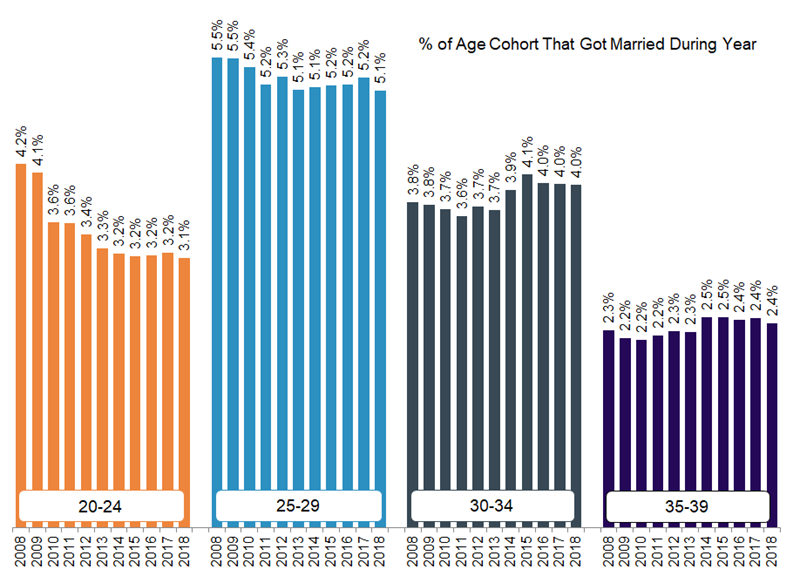
In fact, looking at young adults that would seemingly be most at risk of having a different perspective on marriage today versus older generations, we actually find stable-to-increasing propensity to get married of late. Specifically, according to the American Community Survey, 3.1% of 20-24 year olds got married in 2018, barely changed from 3.2% the prior four years. For 25-29 year olds, 5.1% tied the knot, similarly stable with 5.1-5.3% the last seven years.
For 30-34 year olds, 4.0-4.1% got married each of the prior four years, higher than 3.6-3.7% from 2008-13. Lastly, for 35-39 year olds, 2.4-2.5% were married each of the last five years, also higher than 2.2-2.3% from 2008-13. For 30-year olds, the relative uplift in marriage rates would give credence to the idea that while the Great Recession undoubtedly disrupted young adult behavior over the last decade, some of this activity was delayed as opposed to foregone. To us, this offers a vastly different conclusion than the nationwide decline.
By no means do we attempt to defend whether marriage will be more or less in favor as future years unfold, but it is our experience that demographic situations are largely misrepresented because the easy answer of analyzing national trends often overlooks the critical micro dynamics. More than most other sectors of the economy, housing is where these misperceptions create confusion, and at the same time opportunity for those willing to look beyond the commonly-accepted headlines.
Monday, May 18, 2020 by Zelman & Associates
Filed under: Demographics
Looking for More Insightful Content?
Explore our ResearchAffordabilityApartmentsBaby BoomersBuild-For-RentBuilding ProductsConstruction LendingConsumerDemographicsEntry-LevelExisting Home SalesHome ImprovementHome PricingHomebuildingHomeownershipHousehold FormationHousingHousing StartsInstitutional InvestorsInterest RatesM&AMacro HousingManufactured HousingMillennialsMortgageMortgage RatesNew Home SalesReal Estate ServicesRefinanceSG&ASingle-Family RentalSpeakers BureauStocksStudent DebtSupplySurvey