
U.N. Population Reduction Likely First of Many to Come
Thursday, July 14, 2022 by Dennis McGill
Filed under: Demographics
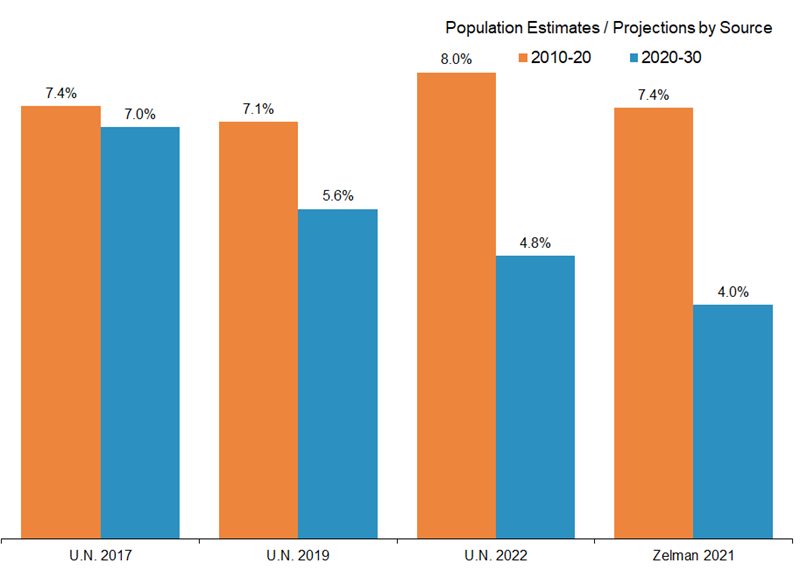
The U.N. now projects a 4.8% increase in the population from 2020-30, revised lower from 5.6% in 2019 and 7.0% in 2017, yet still more optimistic than our 4.0% projection published last August. As another point of comparison, the last projections from the Census Bureau published in 2017 called for a 6.8% increase for the decade. Of the 80 basis point downward revision to the U.N.’s forecast, approximately 40% was attributable to less immigration while the remainder was driven by a weaker domestic outlook.
Although the data provides helpful context for future demographic trends from a reputable source, it is worth noting that while the U.N.’s historical data relies heavily on Census Bureau estimates, several adjustments are made to reported figures and the two data sets do not directly align through time. For instance, the latest Decennial Census estimated a 7.4% increase in population from 2010-20 while the U.N. puts the growth estimate at 8.0%, revised upwardly from its prior projection for a 7.1% increase. As such, relative to its own data set, the U.N. now forecasts the current decade’s growth to decelerate 320 basis points from the prior decade, more severe than 150 basis points in its 2019 release but close to our 340 basis point forecast. Furthermore, the U.N. estimates that population growth for the year ended June 2021 increased 31 basis points while the Census Bureau pegged the increase at just 12 basis points.
Like our forecast, the U.N. assumes that negative pandemic effects fade beyond 2022, with annual growth over the final eight years of the decade (0.50%) expected to be notably stronger than the first two (0.35%). However, our estimates trail off more significantly in the second half of the decade, decelerating nine basis points from 2025-30 versus four basis points for the U.N.
Overall, we see the updated U.N. projections as a reasonable step lower driven by excessive pandemic deaths, continued weakness in fertility rates and lower immigration – a reduction that is likely to be followed by other demographers in the quarters and years ahead. In essence, the “people problem” we highlighted in our August 2021 analysis is slowly becoming more widely acknowledged.
Thursday, July 14, 2022 by Dennis McGill
Filed under: Demographics
Looking for More Insightful Content?
Explore our ResearchAffordabilityApartmentsBaby BoomersBuild-For-RentBuilding ProductsConstruction LendingConsumerDemographicsEntry-LevelExisting Home SalesHome ImprovementHome PricingHomebuildingHomeownershipHousehold FormationHousingHousing StartsInstitutional InvestorsInterest RatesM&AMacro HousingManufactured HousingMillennialsMortgageMortgage RatesNew Home SalesReal Estate ServicesRefinanceSG&ASingle-Family RentalSpeakers BureauStocksStudent DebtSupplySurvey