
Shift in International Immigration Slows National Population Growth, NY and NJ Growth Most Impacted
Tuesday, February 10, 2026 by Kevin Kaczmarek
Filed under: DemographicsHomeownershipHousehold Formation
Census recently released updated population estimates for the year ending July 1, 2025, showing growth slowed to 0.52%, the slowest since COVID-impacted 2020, driven by a significant deceleration in international immigration. State-level detail showed VT, HI, WV, NM and CA ranking at the bottom, with growth rates of negative 0.02% to negative 0.29%, and SC, ID, NC, TX and UT ranking at the top with growth of positive 1.03% to 1.45%. While we provide more highlights and the implications for the housing market below, you can access 15+ years of state population, immigration and building permit data on our interactive website.
At a national level, births net of deaths remained largely stable, as is typical, at 0.15% of the year-ago population, equal to the prior two years, with no state experiencing a greater-than five basis point change from the year prior. Looking at domestic immigration, or movements between states, SC, ID, NC, DE and TN were again the biggest beneficiaries (all were top five in the prior year as well), with inbound movers, net of people leaving the state, adding 0.58-1.21% to their populations. On the other hand, NY, HI, AK, DC and CA saw the biggest net outflows, with the number of people leaving the state outpacing the number entering by an amount equivalent to 0.58-0.69% of their populations. All but DC stood in the bottom five the prior year as well.
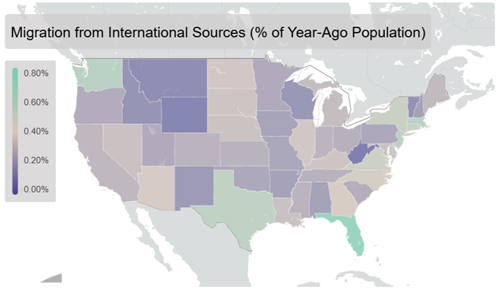
International immigration includes both documented and undocumented immigrants. It typically accounts for the vast majority of swings in national population growth. Last year, it slowed to 1.3 million people (0.37% of the population), down from 2.7 million (0.81%) the year before. States that saw the largest inflow of people from other countries, net of residents departing for other countries, included FL, WA, DC, MA and NJ which saw net international immigration add 0.56-0.77% to their populations. NY and NJ saw the largest deceleration in net immigration versus the prior year, with net immigration of 0.48% and 0.56%, down 99 and 73 basis points from the prior year, respectively.
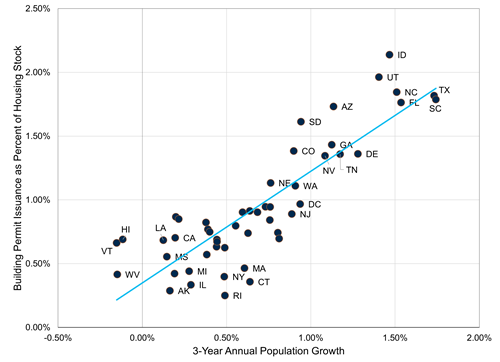
What are the implications for housing? While household formation is a more direct driver of housing demand than population growth, the latter remains an important factor and we expect home construction activity in states with higher population growth will be two to three times higher than states with lower growth, even after adjusting for the level of population. For instance, the 15 slowest-growing states over the past three years, accounting for 34% of the population and averaging annual population growth of 0.17% saw annual building permit issuance equivalent to 0.60% of housing stock over the same time frame. On the other hand, in the 14 fastest-growing states, also accounting for 34% of the population, annual population growth averaged 1.28% and home construction activity was more than two-and-a-half times greater, with annual permit issuance equal to 1.59% of housing stock.
Zelman Data Overview
Zelman’s research now goes further, giving you tools to deepen your analysis and sharpen your edge. Use our insights as a foundation – then build your own. Our data-centric platform offers an intuitive, user-friendly experience, making it easier than ever to access our powerful research tools. With interactive, customizable data and an improved client dashboard, there has never been a better time to work with Zelman.
Tuesday, February 10, 2026 by Kevin Kaczmarek
Filed under: DemographicsHomeownershipHousehold Formation
Looking for More Insightful Content?
Explore our ResearchAffordabilityApartmentsBaby BoomersBuild-For-RentBuilding ProductsConstruction LendingConsumerDemographicsEntry-LevelExisting Home SalesHome ImprovementHome PricingHomebuildingHomeownershipHousehold FormationHousingHousing StartsInstitutional InvestorsInterest RatesM&AMacro HousingManufactured HousingMillennialsMortgageMortgage RatesNew Home SalesReal Estate ServicesRefinanceSG&ASingle-Family RentalSpeakers BureauStocksStudent DebtSupplySurvey