
County Population Data Show Strongest Growth in TX and Central FL While Higher-Cost Urban Areas Decelerated Most
Tuesday, March 31, 2026 by Kevin Kaczmarek
Filed under: DemographicsHousehold Formation
County population growth in the year ending July 2025 remained strongest in parts of TX and central FL, while changes in immigration policy appeared to weigh on growth in several higher-cost urban markets. Following the release of state-level population data last month, Census recently released county-level population estimates for the year ending July 2025. In the following analysis, we focus on the 300 largest counties, each having at least 243,000 people, but make the full data set available on our website and, for the largest markets containing over 600 counties, we have data on housing-related demand and supply drivers as well.
Among the 20 fastest-growing large counties, populations increased 2.5-4.6%, with seven in FL (mostly center of the state), five in TX (mostly Austin and Houston) and three in SC. Interestingly, 18 of these top 20, or 90%, saw a deceleration in growth from the prior year, primarily driven by a decrease in international immigration. Looking more broadly, a similar share (89%) of the 300 largest counties also saw a deceleration in population growth from the prior year.
As a reminder, at a high level, local population growth consists of natural growth, (births net of deaths), net domestic migration (moves into a county from other U.S. counties) and net international migration (moves into a county from sources outside the U.S.). Leaders in natural population growth, where 2025 births net of deaths equaled 1.2-1.3% of the prior year's population, included Rockland County, NY (NYC market) and Utah County, UT (Provo) while retirement markets such as Yavapai County, AZ (Prescott) and Sarasota County, FL lagged the most. Notably, with an eye on a potential up-and-comer, York County, SC (Charlotte) saw the largest acceleration in natural growth which increased 17 basis points to 0.34%.
As for domestic migration, Pinal County, AZ (Phoenix) and St. Johns County, FL (Jacksonville) led the pack with inbound movers, net of those leaving, comprising 3.8-4.1% of the previous year's population. On the other hand, Miami-Dade County and Dallas County, TX (Dallas / Fort Worth) trailed in domestic migration where net outflows equaled 1.7-2.6% of the prior year's population.
International migration was the largest swing factor, with all of the top 300 counties seeing a deceleration in net international migration as a percent of the prior year's population, though only Tulare County, CA (Visalia-Porterville, CA) saw net negative international migration. Those seeing the largest reduction in international immigration as a percent of population included Webb County, TX (Laredo) and several counties in NYC (Queens, Bronx and Kings / Brooklyn) though, as mentioned previously, net international immigration did remain positive in these areas.
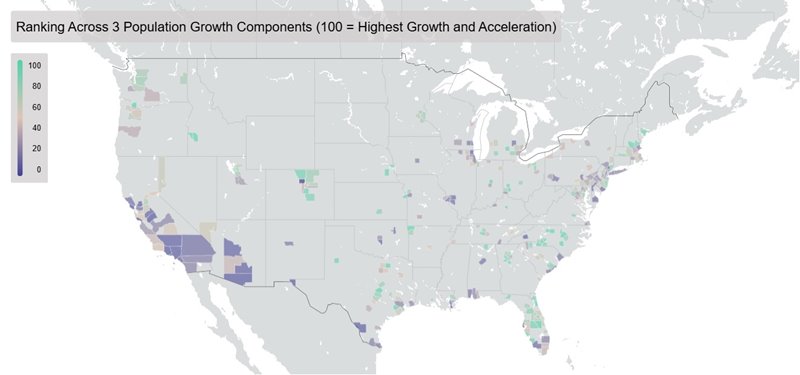
Putting it all together, while we previously highlighted some of the faster growers, in order to measure the breadth of growth components, we ranked each of the 300 largest counties in terms of the three aforementioned population growth drivers, as well as their respective accelerations/decelerations from the prior year. Those counties that ranked the highest in terms of these three growth and acceleration components included Benton County, AR (Fayetteville), Osceola County, FL (Orlando) and Clark County, WA (Portland, OR). In these counties, natural growth and domestic migration remained solid and accelerated from the prior year, while net international immigration decelerated only moderately from the prior year. On the other hand, urban counties with some of the highest costs of living ranked lowest, including New York County / Manhattan (NYC), Santa Cruz County (Santa Cruz-Watsonville, CA), CA and Marin County, CA (San Francisco).
Tuesday, March 31, 2026 by Kevin Kaczmarek
Filed under: DemographicsHousehold Formation
Looking for More Insightful Content?
Explore our ResearchAffordabilityApartmentsBaby BoomersBuild-For-RentBuilding ProductsConstruction LendingConsumerDemographicsEntry-LevelExisting Home SalesHome ImprovementHome PricingHomebuildingHomeownershipHousehold FormationHousingHousing StartsInstitutional InvestorsInterest RatesM&AMacro HousingManufactured HousingMillennialsMortgageMortgage RatesNew Home SalesReal Estate ServicesRefinanceSG&ASingle-Family RentalSpeakers BureauStocksStudent DebtSupplySurvey