
Housing CPI Versus Reality
Thursday, March 12, 2026 by Mark Franceski
Filed under: ApartmentsSingle-Family Rental
This week, the Bureau of Labor Statistics reported Consumer Price Index results for February and, as we have since early 2022, we broke down the housing component and its impact on overall inflation. Housing CPI increased 3.1% year over year, the 53rd straight month of at least 3% growth, and well above other measures of rent growth. Here we take a less technical approach to the topic, discussing why we think it’s important, how it stacks up against other rental market data, and thinking about how it might behave in the future.
Why Do We Regard Housing CPI As So Important?
There are two main reasons:
- The housing component of CPI is based on apartment and single-family rental data, two sectors where Zelman has deep knowledge. We can provide essential insight into housing CPI because we both understand the rental market data better than anyone and have investigated the government data methodology more closely.
- More important, since shelter accounts for the largest share of the CPI (36%), understanding housing inflation provides a significant advantage to understanding overall inflation.
We acknowledge the many vocal detractors of housing CPI, owners’ equivalent rent in particular. We maintain our belief that the concept has economic merit and deserves inclusion in some measure of inflation. Whether it should be weighted so heavily, or considered by policymakers when setting monetary policy, is a debate for another time. Luckily, inflation can be measured excluding shelter, this month registering growth of 2.1%, much closer to the Fed’s target.
Why Housing CPI Differs From Other Rent Measures
Even we must acknowledge some confusion about the lag inherent in government rental data. Much of this can be explained by complex methodology, sample construction, and pandemic effects, but it still makes sense to ask, “Why can’t housing CPI results be more similar to the rest of the data I look at?” This chart shows the persistent post-pandemic spread between annual housing CPI growth and other measures. The most important difference is that most other metrics cover only apartments, while we use our proprietary survey data on both apartments and SFR. Zillow also produces a rental index that includes both types. It is no coincidence that those two growth rates are closest to the BLS measure.
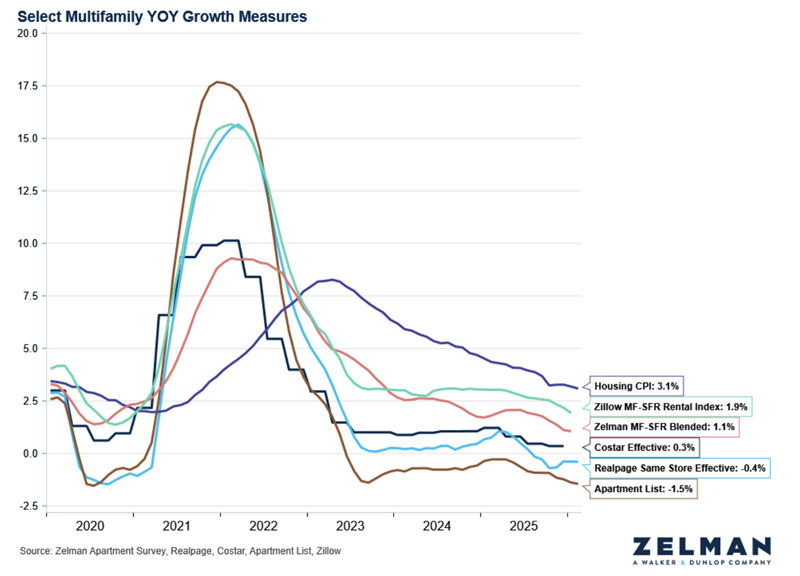
So where does housing CPI go from here? We are on the record as stating that we believe it will continue to decelerate at an increasing pace, though that pace has been gaining momentum only slowly. After unexpected upticks following data releases affected by last year's government shutdown, we think housing CPI is poised to fall more in line in the coming months. Next month could bring the first sub-3% annual increase in over five years. We’ll be watching.
View our full report library for in-depth macro housing analysis.
Thursday, March 12, 2026 by Mark Franceski
Filed under: ApartmentsSingle-Family Rental
Looking for More Insightful Content?
Explore our ResearchAffordabilityApartmentsBaby BoomersBuild-For-RentBuilding ProductsConstruction LendingConsumerDemographicsEntry-LevelExisting Home SalesHome ImprovementHome PricingHomebuildingHomeownershipHousehold FormationHousingHousing StartsInstitutional InvestorsInterest RatesM&AMacro HousingManufactured HousingMillennialsMortgageMortgage RatesNew Home SalesReal Estate ServicesRefinanceSG&ASingle-Family RentalSpeakers BureauStocksStudent DebtSupplySurvey