
Oil Price Spike Risks Producers’ Profitability Aspirations
Thursday, March 19, 2026 by McClaran Hayes
Filed under: Building Products
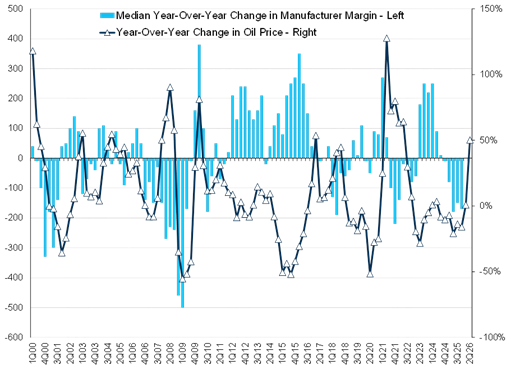
As the conflict in Iran stretches into its third week, oil prices have jumped higher by 40%-plus since the end of February, and are up by a similar rate on a year-over-year basis. Holding current price levels constant, oil prices are on track to be up by roughly 50% on a year-over-year basis in 2Q-3Q26.
Setting aside any demand impact due to changes in consumer confidence and the broader macroeconomic backdrop, this cost spike provides a more challenging margin set up for suppliers in 2H26. For perspective, coming out of 4Q25 earnings season, we were projecting median year-over-year margin contraction of roughly 200 basis points in 1H26 for manufacturers in our coverage universe, followed by flattish year-over-year margin trends in 2H26.
However, analyzing historical performance from public building product manufacturers in past periods of rising oil costs, we believe suppliers should begin bracing themselves for continued margin pressure. Specifically, dating back to 2000, in prior periods where oil prices increased by 30% or more on a year-over-year basis, manufacturer operating margins declined by a median of 100 basis points on a two-quarter lag. For 40%-plus increases in oil prices, the associated margin pressure steps up to over 120 basis points.
Currently, oil prices are pointing to closer to a 50% year-over-year increase in 2Q-3Q26, but even if prices stepped down to the mid-$80s per barrel, prices would still be up more than 30% on a year-over-year basis. With a typical two-quarter lag as raw materials and production costs move from inventories onto the income statement, it’s likely that producers begin to feel the margin pinch by the end of 3Q26.
Pricing power for suppliers has already been muted in the current backdrop due to depressed levels of end demand, particularly in the new residential end channel. With the 10-year Treasury yield moving higher by 20 basis points since the start of the conflict amid inflation fears, its important to note that any further erosion in end demand for builders is likely to result in continued pressure on suppliers’ ability to pass along cost increases.
Want more insights like this? Reach out and access our full suite of analysis.
Thursday, March 19, 2026 by McClaran Hayes
Filed under: Building Products
Looking for More Insightful Content?
Explore our ResearchAffordabilityApartmentsBaby BoomersBuild-For-RentBuilding ProductsConstruction LendingConsumerDemographicsEntry-LevelExisting Home SalesHome ImprovementHome PricingHomebuildingHomeownershipHousehold FormationHousingHousing StartsInstitutional InvestorsInterest RatesM&AMacro HousingManufactured HousingMillennialsMortgageMortgage RatesNew Home SalesReal Estate ServicesRefinanceSG&ASingle-Family RentalSpeakers BureauStocksStudent DebtSupplySurvey