
Muddling Through an Elongated Trough in Existing Home Sales
Thursday, April 16, 2026 by Ryan McKeveny
Filed under: Existing Home SalesReal Estate Services
Earlier this week, the National Association of Realtors reported its data on March existing home closings, which were down 4% sequentially and 1% year over year on a seasonally-adjusted basis – with the annualized rate of 3.98 million directly matching 2025’s low watermark from June. Considering that mortgage rates were down 80 basis points YoY in February and 50 basis points in March, the results were disappointing, reflecting continued sluggishness in sales activity despite slight improvements in affordability. At the same time, the relative weakness is not overly surprising as Operation Epic Fury began on the final day of February, with gas prices spiking, mortgage rates rising about 50 basis points through the month of March, UMich Consumer Sentiment weakening and economic uncertainty broadly expanding.
Including the lackluster trends in March, existing home closings in 1Q26 were flat YoY on an unadjusted basis and down 1% on a seasonally-adjusted basis. Reflecting the elongated trough in existing home sales, the 4.04 million YTD SAAR for NAR EHS in 2026 is effectively on par with annual sales activity in 2025 (4.06 million), 2024 (also 4.06 million) and 2023 (4.09 million).
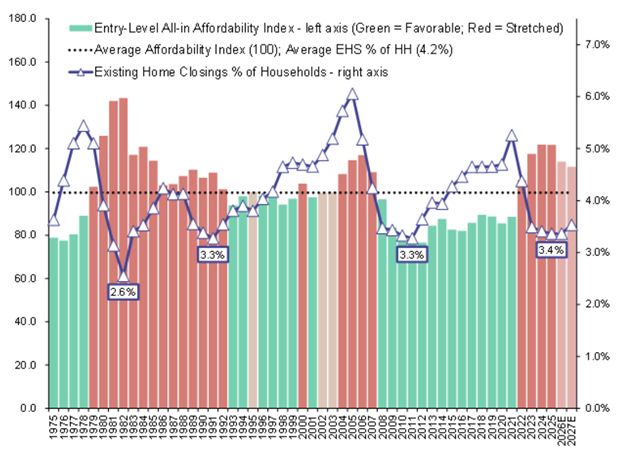
Assessing dynamics on a longer-run basis, we often focus on existing home turnover, or existing home closings as a percent of households. On this basis, turnover equaled 3.4% in 2025, unchanged from 2024, down slightly from 3.5% in 2023 and down sharply from the COVID-peak of 5.3% in 2021. For context, annual turnover troughed at 3.3% in the early 1990s recession and the Great Financial Crisis, highlighting the depressed nature of existing home sales today.
Looked at through an optimistic lens, with existing home turnover averaging 4.2% of households over the long term, the path back to “normalized” turnover implies meaningful growth – about 25% upside from the current levels. However, through a more cautionary lens, we expect the timeline to reach normalized turnover will be lengthy. As highlighted in our recently-updated forecasts for existing home sales, we lowered our 2026-27 projections by 4% in absolute terms, translating to EHS growth of just 1% in 2026 and 6% in 2027. This would equate to turnover at 3.4% and 3.5%, respectively – implying five consecutive years of turnover in a below-average range of just 3.4-3.5% of households.
Unfortunately, elongated periods of subdued sales activity have plenty of historical precedent. Turning back the clock, after annual existing home turnover dropped below the 4.2% long-term average in 1987, it took 11 years to reclaim normalized levels. Likewise, after falling below the long-term average in 2008, turnover did not return to normalized levels until 2015. While we have no doubt that the market will one day return to, and exceed, normalized turnover ratios, history supports our relatively muted outlook for the near-to-intermediate term… as we are “only” three years into the current cycle of below-normal sales trends.
Thursday, April 16, 2026 by Ryan McKeveny
Filed under: Existing Home SalesReal Estate Services
Looking for More Insightful Content?
Explore our ResearchAffordabilityApartmentsBaby BoomersBuild-For-RentBuilding ProductsConstruction LendingConsumerDemographicsEntry-LevelExisting Home SalesHome ImprovementHome PricingHomebuildingHomeownershipHousehold FormationHousingHousing StartsInstitutional InvestorsInterest RatesM&AMacro HousingManufactured HousingMillennialsMortgageMortgage RatesNew Home SalesReal Estate ServicesRefinanceSG&ASingle-Family RentalSpeakers BureauStocksStudent DebtSupplySurvey