
Mortgage Rates, The “Stuck Factor,” and the Return of Housing Mobility
Thursday, April 2, 2026 by Kim Gray
Filed under: Mortgage Rates
At Walker & Dunlop’s recent Investor Day, Ivy Zelman delivered a clear message: today’s housing market is not defined by a lack of demand; it is defined by constraint.
While affordability remains stretched, the more immediate force shaping housing activity is what Zelman describes as the “stuck factor.” Elevated mortgage rates relative to historic lows have fundamentally altered homeowner behavior, limiting mobility and suppressing transaction volume, even as underlying life events continue to drive movement.
This dynamic is critical for those navigating today’s market environment, particularly as capital allocation, asset valuation, and portfolio strategy increasingly depend on understanding when and how mobility returns.
The “stuck factor”: a structural constraint on housing supply
Mortgage rates hovering around 6 percent represent a significant shift from the ultra-low rate environment of the COVID-19 era. During that period, millions of homeowners locked in financing below 5 percent, creating a powerful disincentive to move today.
Zelman’s data highlights the scale of this lock-in effect:
- Two years ago, over 90 percent of homeowners had mortgage rates below 5 percent
- Today, approximately 69 percent remain below 5 percent
- By 2027 (projected): that figure may decline to ~59 percent, assuming rates stabilize
This creates a structural bottleneck. Homeowners are reluctant to exchange low-cost debt for higher borrowing costs, even if their housing needs have changed. The result is constrained inventory and suppressed transaction activity, despite demographic and lifestyle drivers that would typically support higher turnover.
The 4 Ds: what’s driving housing mobility today
In a normal market, housing mobility is fueled by both necessity and choice. Today, that balance is skewed.
Zelman frames this dynamic through the “4 Ds” of housing mobility:
- Death
- Divorce
- Default
- Discretion
The first three drivers, largely unavoidable life events, continue to generate baseline transaction activity. However, the fourth driver, discretion, has been notably absent. Discretionary moves such as upsizing, downsizing, or relocating for lifestyle are highly sensitive to financing conditions. With mortgage rates elevated, many households are choosing to stay put.
This explains why transaction volumes are currently running at approximately 3.4 percent of households, a level historically associated with recessionary conditions. Yet, unlike prior downturns, home prices have remained relatively resilient.
Why prices have held despite weak transaction volume
One of the more unusual aspects of today’s market is the divergence between activity and pricing. Historically, declining transaction volume has coincided with falling home prices. Today, limited supply has offset weak demand, supporting price stability at a national level.
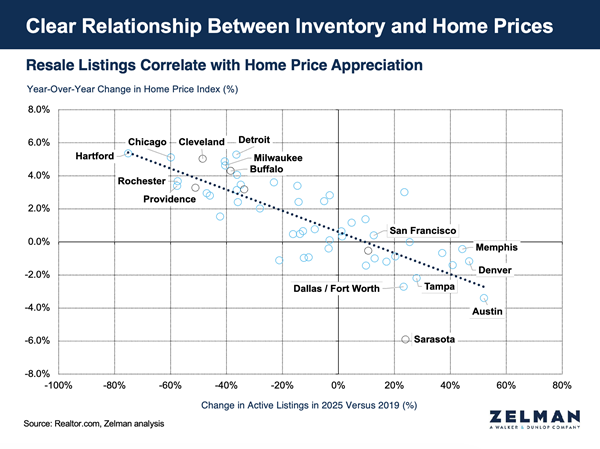
Inventory remains constrained relative to household formation, particularly in regions where new supply has not kept pace. This imbalance has allowed prices to continue rising modestly, even as affordability pressures persist.
However, the market is not uniform. For example, Sunbelt markets are experiencing higher inventory levels due to recent overbuilding, which is putting pressure on prices and increasing seller concessions. Midwest and Northeast markets continue to see tighter supply and stronger price support. This regional divergence underscores the importance of localized strategy for clients evaluating acquisition, disposition, or development opportunities.
Mortgage rates, spreads, and what comes next
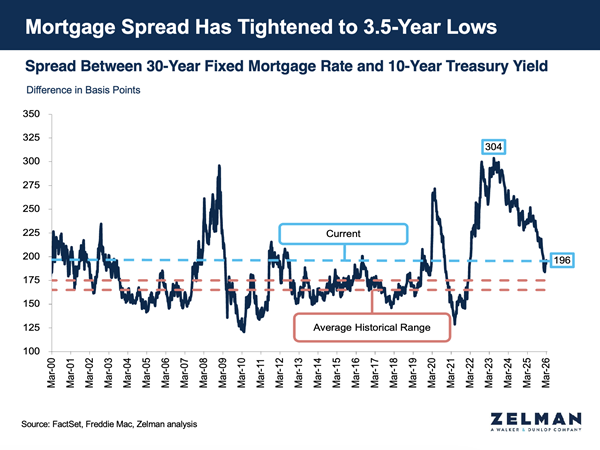
Mortgage rates are influenced not only by benchmark yields but also by spreads — particularly the spread between the 10-year Treasury and the 30-year fixed mortgage rate. Zelman noted that spreads, which had exceeded 300 basis points, have compressed to roughly 190 basis points. This has helped bring mortgage rates modestly lower, though they remain elevated relative to recent history.
Looking ahead, expectations are for:
- Gradual, not dramatic, rate movement
- Continued sensitivity to Treasury yield fluctuations
- Incremental improvement rather than rapid normalization
This reinforces the expectation that housing recovery will be a “slow grind,” not a sharp rebound.
Early signs of mobility returning
While discretionary movement has been limited, there are emerging signs of improvement. Households are beginning to accept that life transitions cannot be postponed indefinitely. Over time, this behavioral shift is expected to reintroduce discretionary moves into the market.
Zelman anticipates:
- Modest increases in existing home transactions beginning in 2026
- Continued improvement into 2027, albeit from historically low levels
- Gradual normalization rather than a surge in activity
For clients, this suggests a window of strategic positioning, particularly in markets where supply-demand imbalances are beginning to recalibrate.
Implications for rental housing demand
The “stuck factor” is also reinforcing demand for rental housing.
Key trends include:
- Single-family rental payments are approximately 30 percent lower than homeownership costs today
- Rental household growth is outpacing owner household growth
- Both multifamily and single-family rental sectors are gaining share
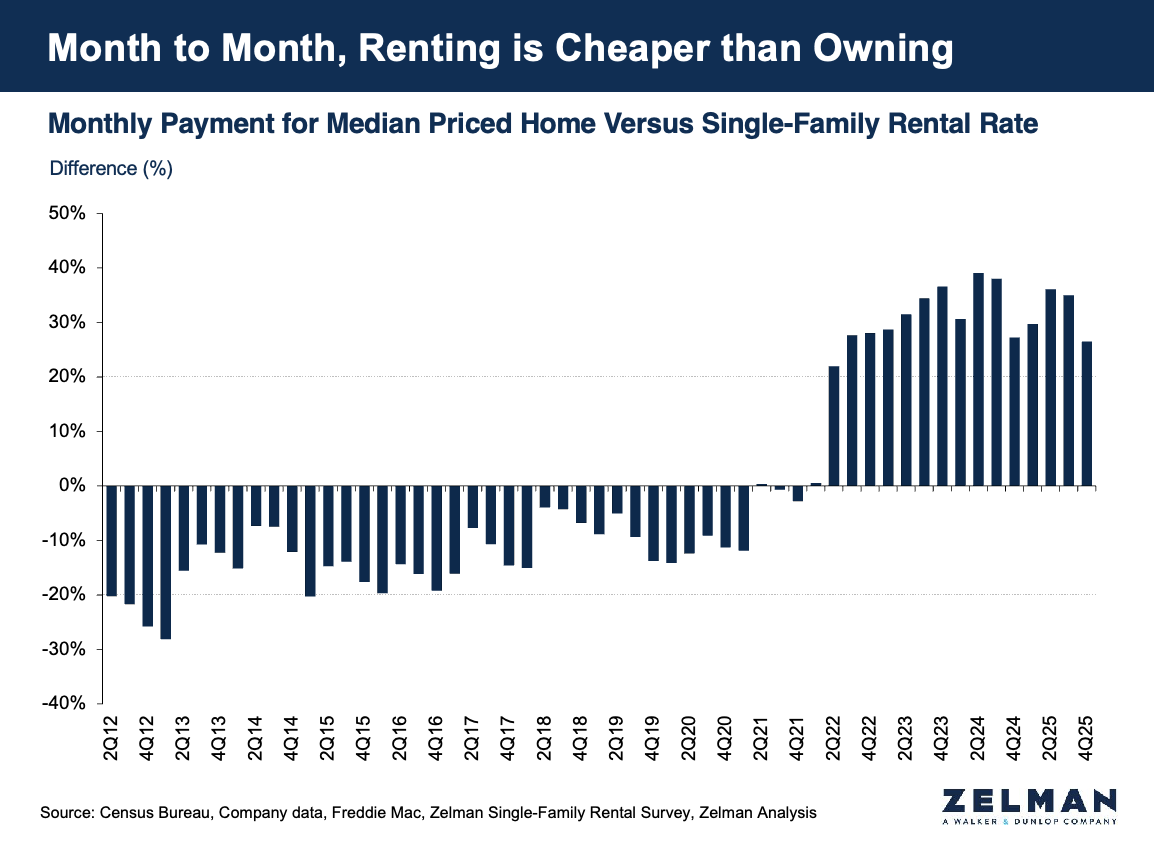
This shift reflects both affordability constraints and changing consumer preferences, particularly among younger households that are increasingly prioritizing flexibility over ownership. For investors, this reinforces the long-term strength of rental housing fundamentals, even as rent growth moderates in the near term.
A market defined by patience and positioning
Today’s housing market is not frozen, but it is constrained. Mortgage rates have created a powerful lock-in effect, limiting discretionary mobility and suppressing transaction volume. At the same time, structural supply shortages and demographic demand continue to support pricing and rental demand. The path forward is not about rapid recovery. It is about gradual normalization.
For Walker & Dunlop clients, this environment calls for:
- Strategic patience in capital deployment
- Market-specific analysis rather than broad assumptions
- A focus on long-term fundamentals over short-term volatility
As mobility slowly returns and the “stuck factor” begins to ease, those positioned with clarity and discipline will be best equipped to capitalize on the next phase of the housing cycle.
Want more insights like this? Reach out and access our full suite of analysis.
Thursday, April 2, 2026 by Kim Gray
Filed under: Mortgage Rates
Looking for More Insightful Content?
Explore our ResearchAffordabilityApartmentsBaby BoomersBuild-For-RentBuilding ProductsConstruction LendingConsumerDemographicsEntry-LevelExisting Home SalesHome ImprovementHome PricingHomebuildingHomeownershipHousehold FormationHousingHousing StartsInstitutional InvestorsInterest RatesM&AMacro HousingManufactured HousingMillennialsMortgageMortgage RatesNew Home SalesReal Estate ServicesRefinanceSG&ASingle-Family RentalSpeakers BureauStocksStudent DebtSupplySurvey